
Publication
- Forecasting nonlinear adaptation in human-water systems
- C. Dionisio Pérez-Blanco
- Environmental Research: Water, Volume 2, Number 3
Water scarcity and extremes are existential threats to many parts of the world, with broad systemic impacts on societies, economies, and the environment. Environmental and socioeconomic change is triggering what scientists call nonlinear adaptive responses – changes in human behaviour that are not directly proportional to the pressures people face, and that can set off large-scale, sudden, or structural shifts.
One stark example is the decision to steal water – triggered, for instance, by a drop in water availability or a shift in crop prices. Water theft already accounts for a staggering 30% to 50% of the global water supply.
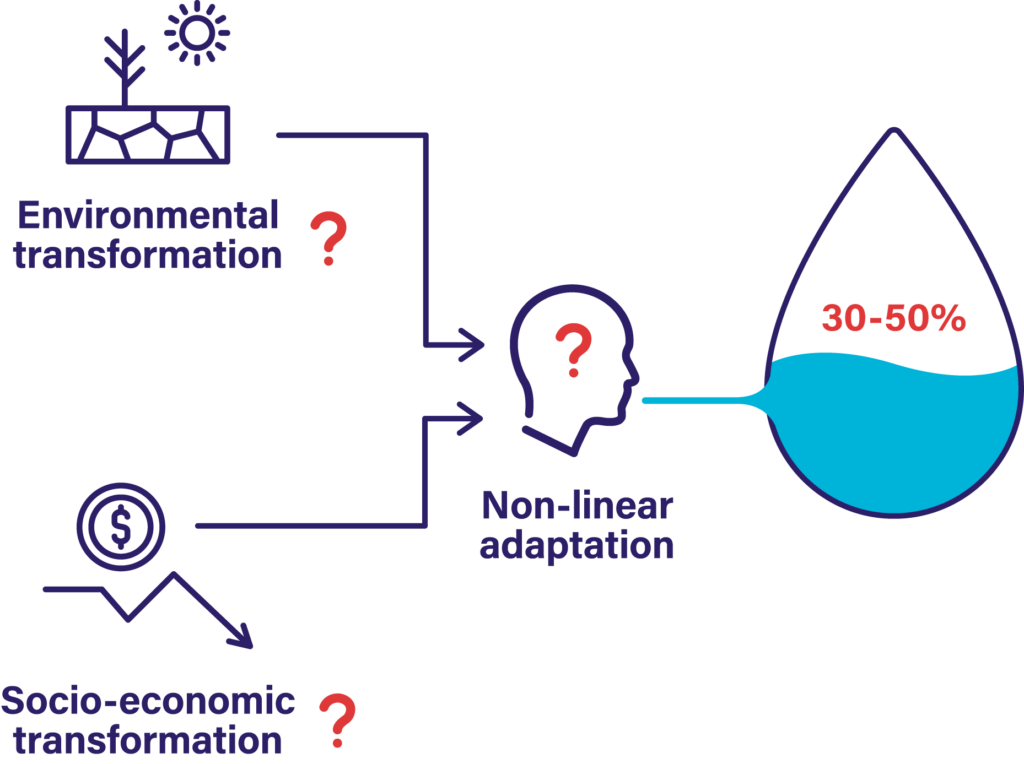
Today, the methods to predict these behaviors, and therefore plan more effective responses to it, are not available. While natural systems research has formalized nonlinearities into a mathematical concept with potentially predictive skills, water economics and human-water systems research still relies on representations of human agency based on relationships observed in historical data, and in isolated domains (e.g. a river basin). This assumes the local past to be a reliable predictor of the future – an assumption that neglects nonlinearities originating in human systems and undermines our ability to predict them.
This is not just a theoretical gap, it has real consequences for how we manage water. At present, state of the art models are not sufficient to predict these adaptation surprises, let’s see why.
State of the art models are unfit for predicting nonlinear adaptive responses. As water availability and policies deviate from historical conditions, the adaptive responses of irrigators are increasingly often abrupt and disproportionate, significantly deviating from what conventional microeconomic models forecast. Empirical models, on the other hand, can explain surprising behaviour after the fact – but they struggle to anticipate it under new or unfamiliar conditions, which limits their forecasting value.
State of the art models ignore spatial interactions in human systems. Current human-water system models have focused on the study of individual behaviour and how it drives emergent patterns over time, ignoring the interconnections between the adaptive responses of individual agents – such as irrigators – and other socioeconomic dynamics emerging across space.
State of the art models neglect institutional aspects. Beyond incremental policies, institutions may also exhibit nonlinear behaviour themselves – for example, by adopting transformational policies such as water markets – which may in turn trigger nonlinear adaptive responses by individual agents.
State of the art models do not sufficiently quantify uncertainty. Uncertainty quantification in water economics models is limited to local sensitivity analyses of policy or climate scenarios that do not properly explore the space of input factors, while ensemble experiments are virtually nonexistent.
So, what can be done?
Better models of human behaviour. The solution is not to abandon the rigour of economic models, nor to give up on the richer – if less generalizable – insights from behavioural experiments. Instead, the two need to be combined. By feeding the findings of experimental economics into the formal structure of microeconomic models, scientists can build tools that are both realistic and broadly applicable. A key ingredient is focusing on so-called “deep parameters” – stable drivers of human behaviour such as personal preferences – rather than variables that shift with every change in prices or policies. Crucially, new data sources are making this more feasible: satellite imagery, for instance, can now track farmers’ long-term investments in permanent crops, helping researchers detect behavioural patterns like “sunk cost bias” that were previously impossible to quantify at scale.
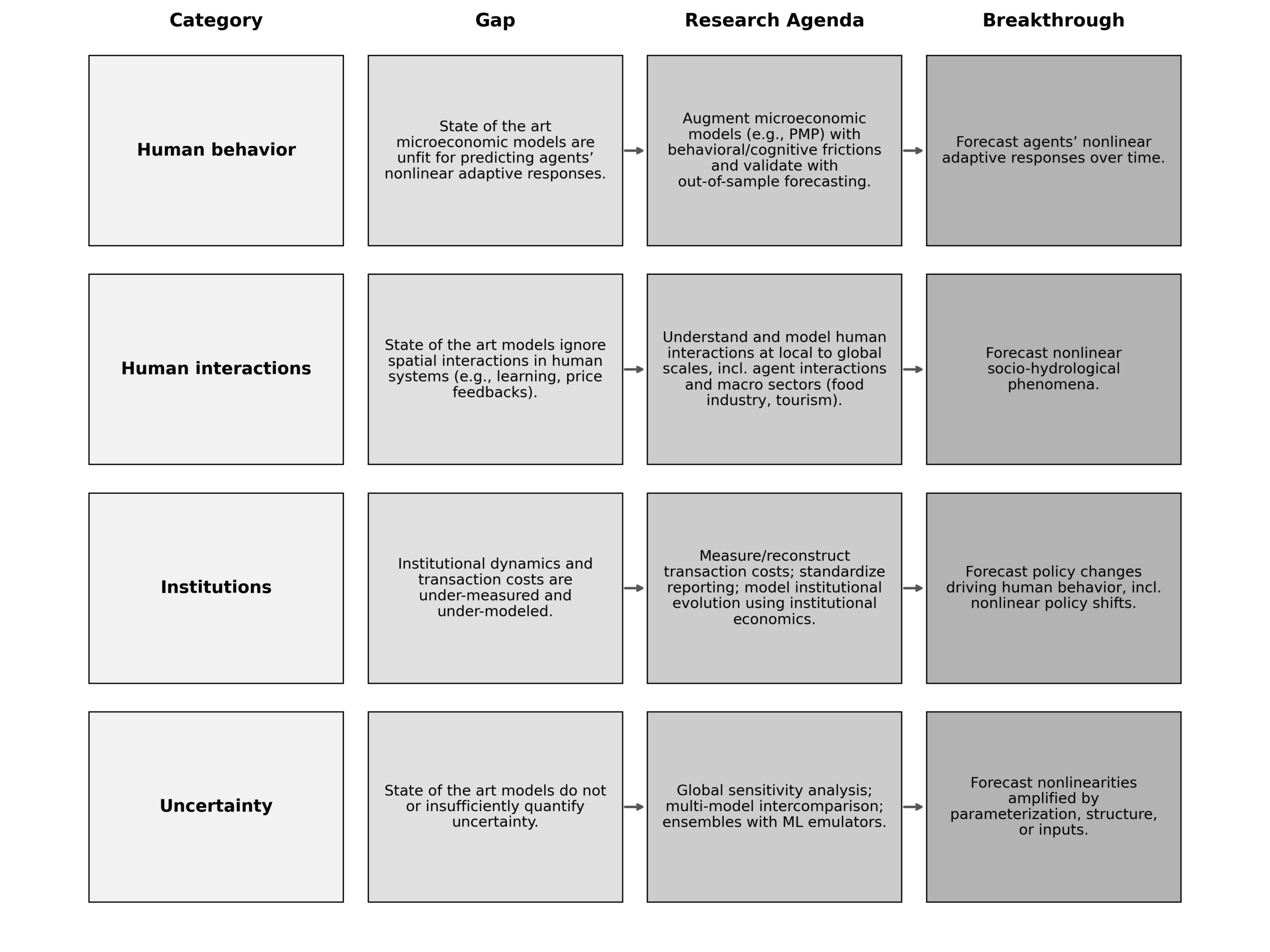
Better models of human interactions. People don’t make water decisions in isolation – they watch their neighbours, respond to market signals, and are influenced by dynamics playing out hundreds of kilometres away. Current models largely miss this. The way forward is to connect models operating at different scales: from individual farms, to regional networks, to national and global markets. This is technically challenging and computationally expensive, but machine learning is opening new doors. So-called “metamodels” can learn to approximate the behaviour of complex, costly simulations at a fraction of the cost – scanning vast spaces of possible outcomes, flagging tipping points, and guiding more detailed analysis only where it is most needed.
Better models of institutions. Institutions – the rules, rights, and enforcement mechanisms that govern water use – are a largely overlooked driver of nonlinear responses. A government amnesty on illegal abstraction, or the introduction of water markets, can cascade into entirely unexpected behavioural shifts. Anticipating these institutional moves requires long-term records of how governance systems have evolved and whether they are meeting their objectives. This data – on transaction costs, enforcement capacity, and policy effectiveness – is rarely collected systematically today. Building it up, retrospectively and prospectively, is essential. AI tools can help fill historical gaps, while a shared international “transaction cost observatory” could ensure future data is collected in a consistent and comparable way.
Better uncertainty quantification. All models are simplifications, and some degree of uncertainty is unavoidable. The problem is that water economics models have so far done little to map and communicate that uncertainty systematically. The toolkit exists – global sensitivity analyses, model intercomparison experiments, and ensemble approaches are already standard practice in climate science – but it has barely been applied to human-water systems. Adopting these methods, and making them computationally affordable through machine learning emulators, would give scientists and policymakers a much clearer picture of the range of futures they may be facing – including the most surprising ones.
Stay tuned for insights into our first results, data and models you will be able to use in your own context.